PAGE 4 – FARMING GUIDE (work in progress)
I discovered Klondike when I was searching for another farming game. I like this type of games, even though I’ve never ploughed a garden in my life (only plants in vases, helping my mother). Klondike was pointed to me as a “farming oriented game” in a third part website. The graphics are gorgeous, so I thought I would build a beautiful assorted farm. False advertisement? More or less. It is true that there is a farming aspect in the game, but it is also true that farming is not the main focus of Klondike at all. At Klondike, your farm serves merely as a source of raw materials that you need to complete quests, build structures and make energy snacks. However once you complete the quests and build a somewhat stable chain of production, the only thing left that you will need to harvest is Rye.
Note: If you plan to raise birds, you may also benefit from harvesting Cotton crops, but it’s not required. Far from it, the only crop really required to play the exploring part of the game is Rye.
ASPECTS OF FARMING – FULFILLING QUESTS
During your adventures through the many Klondike’s Permanent Lands, you’ll be prompted to fulfil quests to progress the storyline. These quests require you items, which must be produced new. Regardless of how many items you already have at your Storage, you are prompted to get more of it. E.g. if a quest asks for 3 Windows, you have to make them, even if you already have thousands of Windows stored.
Note: If a quest asks for an item that you cannot make at any building, it can be bartered somewhere else. You may check your Observation Tower to search where to make it. Rarely will it be bartered in a land you have not opened yet. The main example is the Old Depot’s quest line. You can finish it only after clearing some lands at Extinct Sea.
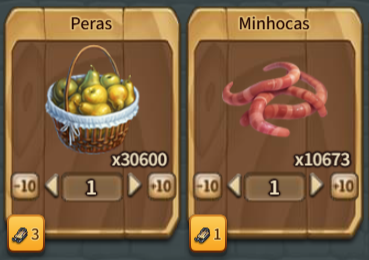
In this context enters Klondike’s Farming. If a quest asks for 200 Pears, you have to harvest Pear Trees for new Pears, or barter for Pear Boxes at Sunrise (a Permanent Land). Fortunately most quests will not ask for the raw harvest (e.g. Beets or Cotton), but for items made with them (Red Ribbons or such). Therefore, most of the time, you can harvest Crops or Trees in advance for quests. You should produce things in advance, but only when you already know they will be eventually required. You practically will not use Watermelons for anything, so there is no reason to invest time and resources harvesting them.
Tip: What is the best order for farming? Concomitantly. Set at least one Vegetable Complex on repeat for each crop you know you will eventually use. As time passes by, you will amass a large amount of vegetables, and when the time to fulfil a quest appears you will not need to wait for the crops to grow. Do this specially for the vegetables bartered at Ukthy and Cotton. After you complete the main quest line, you can convert all your complexes to harvest Rye (and perhaps let some for Cotton).
ASPECTS OF FARMING – BUILDING AN INDUSTRY.
If you want to build a thriving industry in Klondike, you’ll need to farm for it. No chain of production in Klondike makes any sense; this would not be an exception! At least this convoluted puzzle only happens during the very first phase of the game. After you set everything in motion, it becomes very easy to get any item or build anything. It is ironic that at first you will struggle so much to get a Tile, a Brick or a Window. A couple months later, you will sell thousands of extra items because you have no use for them anymore.
Note: If you play the game at the official Portal, ask me for these items. I give them for free.
Let’s see how the starting game phase runs:
-
- In order to produce manufactured or industrialized goods, you need workforce.
- To hire a workforce, you need to house them first.
- To house them, you need beds and pillows for their rooms.
- To make beds and pillows, you need Cotton and Beets. Lots and lots of Cotton and Beets.
The very first bottleneck you will encounter as a new player is the huge amount of Cotton required to have a minimally decent industry. As each harvest of Cotton takes 32 hours of waiting (and money you usually don’t have now), getting Cotton forces this starting phase to be painfully slow. You cannot produce enough goods fast without workers and you cannot build more housing without goods. The small manufactories output only one item per batch and hold at most 3. So, for some time you will be stuck with small houses and small manufactories.
It is recommended that you build bigger houses and full factories as soon as you amass enough resources. Much more powerful than manufactories, full factories will output 10 times more goods using a fraction of your Home Station’s space. They require from 10 to 15 workers to function, whom can be accommodated at Hotels (I believe game’s translation would be “Skyscrapers”).
Note: You do not need housing if you plan to hire Inuks. This approach requires Emeralds, which can be earned for free or acquired with real life money. As usually the construction of an industry complex is done during the first phase of the game, new players may not be willing to spend money to do so. But if you do, it will speed up your progress drastically.
In Klondike, your life as a farmer consists in the management of 3 sources of raw materials, each one has a system of management barely related to the others. Let’s see them.
Types of Farming: Crops, Orchards and Livestock.
Harvesting Crops.
There is a variety of vegetables you can harvest, each one serving a different purpose. You will encounter a considerable high demand for some, while others can be ignored completely. Be sure where to invest your time and resources before starting the production.
In order to harvest Crops, you must expend your own live energy using it at a proper object. Each use will consume 1 live energy regardless the size of the object. Bigger (and more expensive) objects output more vegetables, so you can save lots of energy using them instead of the smaller ones. There are two types of objects used to grow Crops: Hotbeds and Vegetable Complexes.
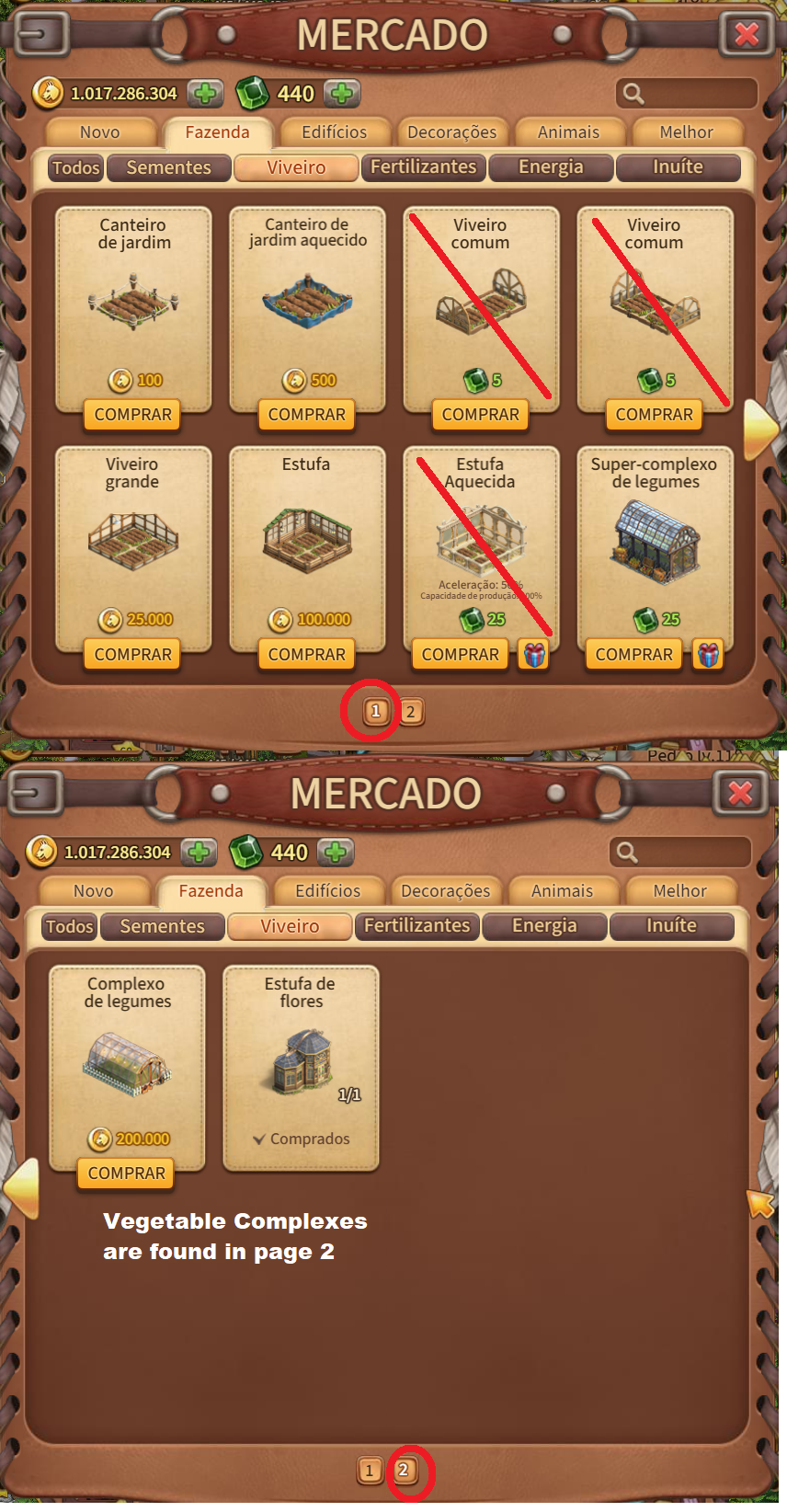
Hotbeds are small fields of land dedicated to grow crops. They may consist of 1, 2 or 4 patches of dirt. Different Hotbeds will be unlocked accordingly to your level in the game. As you progress, better and bigger Hotbeds will be available. Certain vegetables can only be harvested at higher levels.
Tip: You can unlock higher level vegetables using Emeralds, but I see little to no use in doing so. The vegetables required in this first phase are available from the start. If you will spend money, prefer to invest in Super Vegetable Complexes.
To use a Hotbed, first go at Market and select the type you want to buy. You will be prompted to place Hotbeds each new click. Once satisfied, click ”complete” to exit the interface. Now click in any placed Hotbed. You will be redirected to the Market, where you can select which seed you want to buy. After the selection, click in each Hotbed to plant the seeds, and click ”complete” to exit the interface. You can repeat this process for each type of seed you want to plant. Even though you cannot plant different seeds in the same Hotbed, you can place more than one Hotbed side by side and harvest different Crops.
Tip: Large Hotbeds can be stored and even moved to other lands. If you are lacking space at your Home Station, store your Hotbeds, open your Storage interface (they will be in the ”others” tab), put them into your sled and move them elsewhere.
Next step is to wait for the plants to grow. Each vegetable has a different time for harvesting, from minutes do days. After harvesting a Hotbed, you need to plough the dirt before using it again. This process requires no energy or resources and takes only a second, serving just as a cosmetic action.
Main disadvantages of using Hotbeds:
a) Hotbeds have a bad ratio of space x output. They occupy too much space for the amount of crops they yield.
b) Hotbeds cannot be used in sequence. Once a crop is available to be collected, the production stalls, waiting your action to continue.
c) Hotbeds consume seeds, which must be bought each time you run off of them. So, besides energy, they also indirectly consume your Dog Coins to operate.
d) They need to be fertilized manually.
Vegetable Complexes (VC’s) are how greenhouses/glass-houses are called in Klondike. They are also bought at Market and serve to harvest crops, but they have several advantages over Hotbeds.
a) Better ratio of space x output. They occupy less space and produce 75%~150% more crops per energy.
b) VC’s CAN (and should be) used in sequence. These buildings require no workers and can produce indefinitely as long as you set them to ”repeat”.
c) VC’s do not consume seeds to function, they consume units of the selected vegetable.
d) They use fertilizers automatically.
There are 2 types of complexes, the normal one and the Premium one. The Super Vegetable Complex (SVC) works exactly the same as the normal one, but output twice the amount of crops in half of the time, effectively being 4 times better. It is the best object for farming and any serious player should try to get as many as possible of them. In my case, I’ve never paid to get them, even though I have hundreds of them. All were acquired with free Emeralds or traded with other players.
To use a Vegetable Complex, go to the Market and select the one you want to buy. As with Hotbeds, you’ll be prompted to place them the moment you buy. (In the case of SVC, you can also get it from Trading or Gifting.) After placing it, click to open its menu. There you’ll set the orders for growing and fertilizing (optional). Unlike Hotbeds, you don’t use seeds, but you invest your own crops. You need to have a small amount of the crop already stored for it to work. So, for each 1 crop invested, you will profit 7 units.
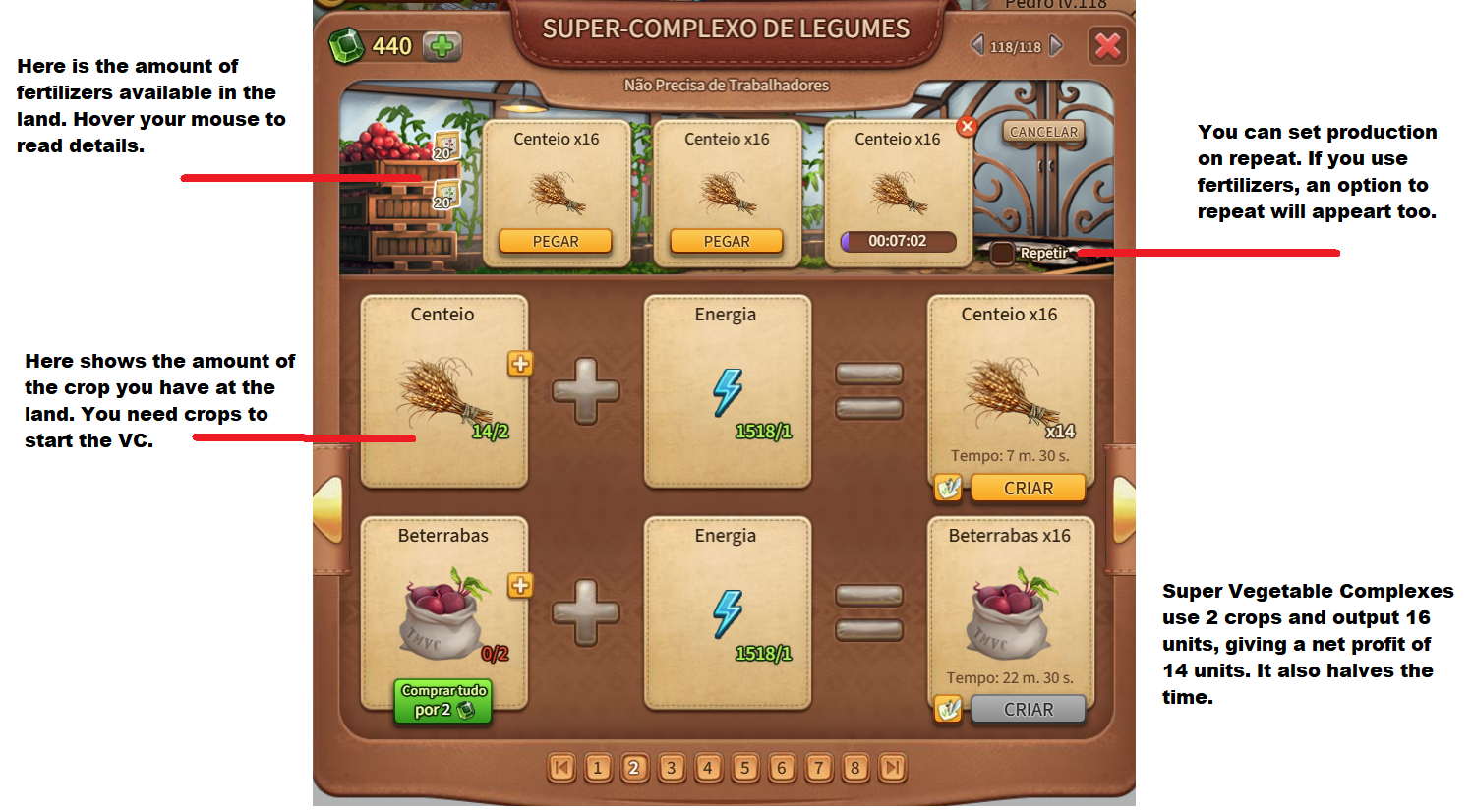
Note: As you cannot start production in a VC if you don’t already have some of the desired crop stored in the land you are working in, you will have to harvest a crop at least once in a Hotbed.
–
Tip.: You can place VC’s in ANY permanent land, not only in the harvesteable ones (Wind Song and Indigo). Aery is a great place for Vegetable Complexes at the start of the game. You can transport vegetables there and cover the land with VC’s.
–
Tip.: If you don’t intend to play Leontius’ Minesweeper Tournament, dd not settle Ukthy. You can harvest an assortment of vegetables there and save the travelling costs.
–
Tip: If you intend to use Apples, do not settle Grenlee and Inti. You can harvest Tomatoes directly at Grenlee. Inti is also a great place, as it is the nearest land from there.
–
Tip: When filling a land with VC’s, you can rotate them while they are inactive. This helps squeeze more of them in the target space like a game of Tetris. :-)
–
Note: You cannot use the Vegetable Complexes to ”store energy”. Just as Hotbeds, Vegetable Complexes use your live energy to harvest crops. However, unlike hotbeds, you can cancel the harvesting. When cancelling a harvesting, you receive your energy and invested crops back. But if you cancel a harvesting while your Energy Bar is already full, you will lose the excess energy, receiving only the invested vegetables back.
Fertilizers don’t make your harvesting output more units, but they grow faster. You can use Fertilizers at any time while growing a crop to diminish the remaining waiting period. There are 3 types of Fertilizers.
a) 30% Fertilizer: it can be bought with Dog Coins at Market. The interface gives you the option to buy 10 or 50 units. As the name implies, it reduces waiting time for a third.
b) 50% Fertilizer: it is the output of your Pigs. Both Pigs and Purebread Pigs drop 50% Fertilizer. Raising Pigs will be seen together in the next section about raising livestock. As the name implies, it halves the waiting time.
Note: Combining 50% Fertilizer and Super Vegetable Complexes is a great way to harvest crops. You can have 2,5 times the output of crops in a quarter of the time. Comparing with the starting Hotbeds, the production of 8 units of Cotton using 8 patches of land takes 32 hours. Fertilized SVC’s use the same space for a net profit of 14 units of Cotton each 8 hours.
c) 100% Fertilizer: it can be bought at Market with Emeralds at any time. It is also earned as rewards for doing temporary lands, gifts from developers etc. As the name implies, it makes the crops grow instantly.
The amount of Fertilizer used seems to be always 4 units, regardless the remaining time. You can only use Fertilizers ONCE per crop, which means you cannot halve the remaining time multiple times. If you cancel production at a Vegetable Complex, you receive your Fertilizers back together with the energy and crops invested. You cannot cancel a Hotbed’s production.
// TODO
// Let’s see each crop and what they are used for.
// Tending Trees
// Raising Livestock
// Speeding up daily chores. Cats, Wigwan, Gardener and Moon Guardian.
// Pictures placeholders